
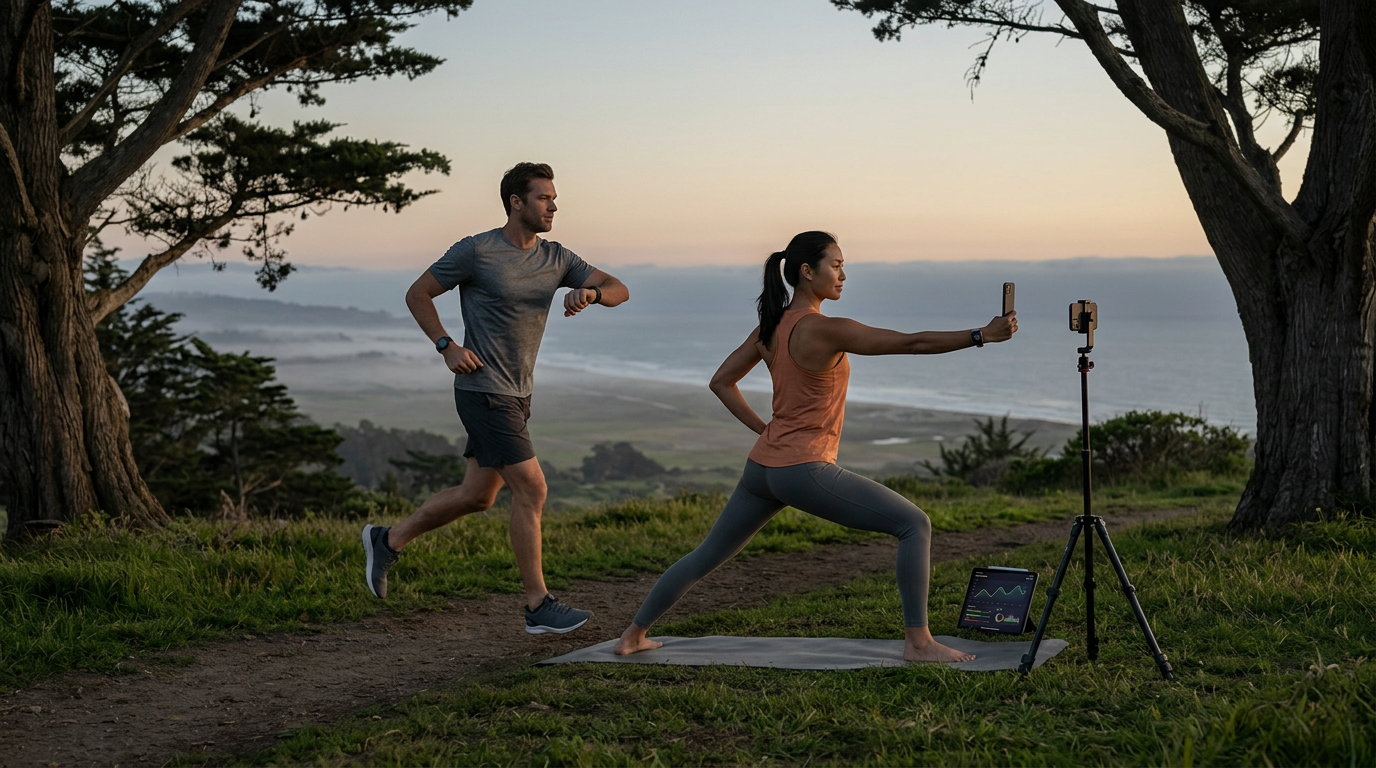
Research on AI coaching for strength training is still in its early stages, but the existing evidence suggests that AI can meaningfully improve training adherence, personalization, and decision-making when it focuses on what it does well: analyzing data, identifying patterns, and delivering timely feedback. AI is not a replacement for expert human coaching, but it fills a significant gap for the majority of trainees who don't have access to a qualified coach and are otherwise relying on generic programs and guesswork.
The Current State of AI in Fitness
The fitness industry has adopted AI primarily in three areas: exercise recommendation, load prescription, and behavioral nudging. Most AI fitness tools use some combination of rule-based systems and machine learning models trained on user data to make training suggestions.
A 2022 systematic review by Kok et al. published in the International Journal of Environmental Research and Public Health examined digital coaching interventions for physical activity. The review found that technology-assisted coaching improved physical activity levels compared to no coaching, with the strongest effects seen when the technology provided personalized, adaptive feedback rather than static recommendations.
Research in digital health coaching has consistently found that adaptive, personalized apps improve user engagement compared to static alternatives. While much of this work focused on general physical activity rather than strength training specifically, the underlying principle holds: personalized, timely feedback improves outcomes.
What AI Does Well in Training
Pattern Recognition Across Training Data
Human coaches are limited by memory and attention. An AI system can analyze every set, rep, and weight across months or years of training data to identify patterns that would be invisible to manual review. This includes detecting when progress has stalled on specific exercises, identifying which rep ranges produce the best results for an individual, and flagging when training volume has drifted away from productive ranges.
This is where AI has the clearest advantage over self-coaching. Most lifters don't analyze their own training logs in any systematic way. They remember how last week felt but not how their bench press progression compared across the last three training blocks.
Personalized Progression Recommendations
Research on autoregulated training (Helms et al., 2018) shows that adjusting training loads based on individual performance data produces better outcomes than rigid percentage-based programs. AI systems can implement autoregulation at scale by analyzing performance trends and recommending when to increase weight, add volume, or pull back.
For example, Kenso uses a rule-based double-progression engine to analyze your training history and recommend weight and rep adjustments after each workout. Rather than following a fixed percentage chart, the system examines how your actual performance has trended and flags when you're ready to progress or when repeated failed sessions warrant a deload.
Timely Behavioral Prompts
One of the most underrated aspects of AI coaching is simply reminding you of the right thing at the right time. A 2020 meta-analysis by Aminov et al. found that text-based health interventions, even simple reminders, improved adherence to exercise programs. AI takes this further by making those prompts contextual: a tip about recovery when your data suggests fatigue, a reminder about progressive overload when you've been lifting the same weight for weeks.
Kenso's AI Coach works on this principle. It's a Claude-powered chat with tool access to your full training history, so it can review your recent workouts and give context-aware guidance grounded in your real data rather than generic advice that applies to everyone equally.
What AI Cannot Do Well (Yet)
Real-Time Technique Correction
Despite advances in computer vision and pose estimation, AI-based form analysis remains unreliable for nuanced strength training movements. A 2021 study by Arrowsmith et al. found that consumer-grade pose estimation tools had significant error margins when assessing complex multi-joint movements like squats and deadlifts, particularly at heavier loads where subtle form breakdowns matter most.
While AI can detect gross movement errors (like a rounded back during a deadlift), it struggles with the fine-grained corrections that matter for performance and safety: bracing quality, foot pressure distribution, bar path deviations, and the difference between productive difficulty and dangerous form breakdown.
Emotional and Motivational Coaching
Human coaches excel at reading an athlete's mental state and adjusting the session accordingly. Knowing when to push someone through discomfort versus when to back off requires empathy, relationship history, and contextual awareness that AI fundamentally lacks. A 2019 qualitative study by Hassandra et al. found that the coaching relationship itself was a significant factor in training adherence, independent of program quality.
AI can provide encouragement and positive reinforcement, but it cannot replicate the accountability and relational dynamics of working with a human.
Programming for Complex Populations
Lifters with injuries, chronic conditions, pregnancy, or other special considerations need programming that accounts for medical context AI systems are not qualified to assess. While AI can implement evidence-based general principles, it should not be making clinical decisions about training around injuries or health conditions.
The Personalization Research Gap
One of the most promising areas for AI in training is true personalization based on individual response data. Traditional programming uses population averages: most people respond well to 10-20 sets per muscle group per week, most people need a deload every 4-6 weeks, most people build strength best in the 3-6 rep range.
But individual variation is enormous. A 2005 study by Hubal et al. found up to 10-fold differences in muscle growth between individuals following the same training program. AI systems that track individual responses over time can theoretically learn each user's optimal volume, frequency, and intensity parameters.
This is still largely theoretical at the consumer level. Most AI fitness apps use collaborative filtering (recommending what worked for similar users) rather than true individual modeling. The gap between what's possible with enough data and what current products actually deliver is significant, but closing.
How to Evaluate an AI Coaching Tool
Not all AI fitness tools are created equal. When evaluating whether an AI coaching feature adds value, consider:
- Data foundation: Does it analyze your actual training data, or does it generate generic advice? The value of AI coaching is directly proportional to the quality and depth of data it works from.
- Transparency: Does it explain its reasoning? An AI that tells you to deload is less useful than one that tells you why, citing the specific performance trends that triggered the recommendation.
- Evidence alignment: Are its recommendations consistent with established exercise science? AI is a delivery mechanism, not a source of truth. The underlying training principles should be well-supported by research.
- Complementary role: Does it position itself as a tool to support your training, or does it claim to replace human expertise? The most honest and effective AI coaching tools acknowledge their limitations.
The Future of AI in Strength Training
The trajectory of AI coaching is toward deeper personalization and better integration with physiological data. Wearable devices that track heart rate variability, sleep quality, and recovery status provide inputs that, combined with training log data, can enable more precise recommendations.
The most likely near-term development is AI systems that effectively bridge the gap between having no coach and having a great one. For the vast majority of trainees who will never hire a personal coach, an AI system that analyzes their training data, provides evidence-based recommendations, and helps them make better decisions about progression and recovery represents a meaningful improvement over training blindly.
Practical Summary
- AI coaching tools are most effective at analyzing training data, identifying patterns, and delivering timely, personalized feedback.
- They are least effective at real-time technique correction, emotional coaching, and programming for special populations.
- The best AI coaching features work from your actual training data, not generic recommendations.
- AI coaching should complement, not replace, your own training knowledge and any human coaching you have access to.
- When evaluating AI tools, look for transparency in reasoning, alignment with exercise science, and honest acknowledgment of limitations.
- The field is improving rapidly, with personalization based on individual response data as the most promising frontier.
Frequently Asked Questions
Can AI replace a personal trainer?
Not fully. AI excels at data analysis, pattern recognition, and consistent feedback delivery, but it cannot replicate the real-time technique correction, motivational coaching, and clinical judgment that qualified human trainers provide. For lifters who can't access or afford a trainer, AI coaching tools significantly improve on self-directed training. For those who have a trainer, AI can complement that relationship with data insights.
How accurate are AI workout recommendations?
Accuracy depends entirely on the quality of input data and the underlying training model. AI systems that analyze your actual performance history and apply evidence-based principles can provide useful recommendations. Systems that generate advice from minimal data or unvalidated models are no better than random suggestions. The key differentiator is whether the AI is working from your data or from generic templates.
Is AI coaching safe?
For general strength training recommendations like progression timing, volume adjustments, and deload suggestions, AI coaching is generally safe because these decisions carry low risk. AI should not be used for medical advice, injury rehabilitation programming, or any context where clinical expertise is required. Reputable AI coaching tools include clear disclaimers about their scope.
What data does an AI coach need to be useful?
At minimum, an AI training coach needs your exercise history: which exercises, what weight, how many sets and reps, and how they've changed over time. Additional data like sleep quality, body weight, subjective readiness ratings, and heart rate variability improves recommendation quality. The more consistent and detailed your logging, the better the AI can serve you.
Will AI coaching get better?
Almost certainly. Advances in personalization algorithms, integration with wearable health data, and larger training datasets will improve the quality of AI coaching recommendations over time. The most significant limitation today is not the AI technology itself but the amount of individual data available to train truly personalized models.